Home / Books

Recommended books for physics

Books I have actually worked through, grouped by topic. Each note says who the book is for and what it asks of you.

Classical mechanics

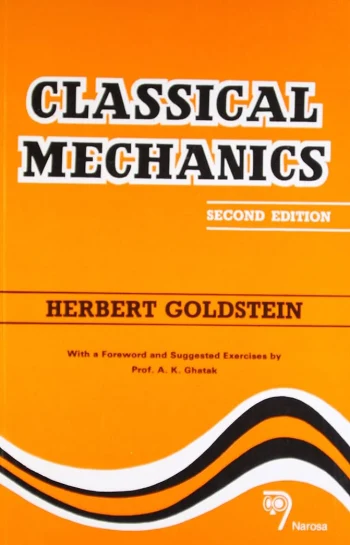
Cover of Classical Mechanics, second edition, by Herbert Goldstein: orange with black and white waves.

Classical Mechanics

H. GoldsteinUndergrad, 2nd year

This book is NOT intended for students who haven’t yet completed a basic classical mechanics course. It’s best suited for those who have a solid grasp of fundamental concepts like momentum, torque, and moment of inertia within the context of elementary classical mechanics. This book stands out as a rigorous mathematical resource and is an indispensable addition to anyone’s classical mechanics studies. Without it, your understanding of classical mechanics may remain incomplete. I strongly recommend this book to undergraduate students in their second year. While it demands a high patience and effort, the rewards are well worth it. To fully benefit from this book, active engagement is essential. You’ll need to work through problems and exercises as there’s no substitute for hands-on learning.
Electrodynamics

Introduction to Electrodynamics

David J. GriffithsUndergrad, 1st year

This book primarily focuses on Electricity and Magnetism, beginning with the basics of electrostatic interactions. It employs university-level calculus and explores various mathematical methods for problem-solving. Notably, this book doesn’t cover the intricacies of 4-vector notation; instead, it maintains an elementary approach. I wholeheartedly recommend this book to first-year students. It serves as a foundational resource that students should certainly explore before diving into more advanced electrodynamics texts. Additionally, towards the end, it briefly introduces relativistic effects, offering students a glimpse into this important aspect of electromagnetism.

Relativity

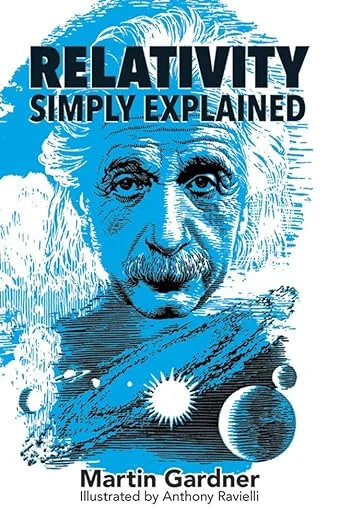
Cover of Relativity Simply Explained by Martin Gardner, illustrated by Anthony Ravielli: a blue and white drawing of Einstein's face over planets and a galaxy.

Relativity Simply Explained

Martin GardnerPopular, no maths needed

Among the numerous books on relativity that I have had the opportunity to read, this one stands out as one of the finest. It distinguishes itself by requiring no prior mathematical expertise, making it an ideal choice for individuals who have not yet entered college but harbor a profound passion for physics. This book presents the concepts of relativity in a manner that is easily digestible, aided by illustrative examples that enhance the reader’s understanding of the subject matter. Readers are sure to find this book not only informative but also genuinely entertaining.

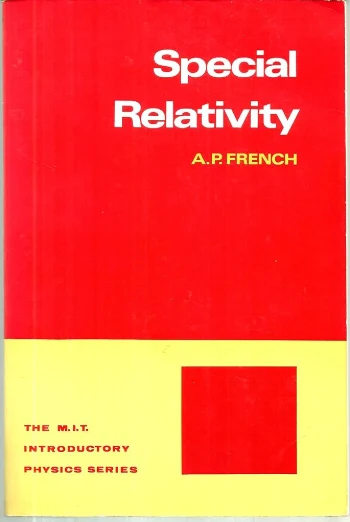
Cover of Special Relativity by A. P. French, from the M.I.T. Introductory Physics Series: red upper half, yellow lower half.

Special Relativity

A. P. FrenchUndergrad

Among the various books I’ve explored on the topic of relativity, this one stands out as the ideal choice for college students embarking on an introductory journey into Special Relativity. It offers a comprehensive account of scientific events and discoveries, presented in chronological order, that gradually paved the way for the development of relativity theory. What truly sets this book apart is its unique approach, immersing readers in the scientific landscape of the late 1800s and early 1900s. As you delve into its pages, you’ll find yourself transported to that era, gaining insights into how theories were formulated, accepted, and eventually found experimentally flawed. While there are several good books available, many focus solely on teaching the fundamental concepts of relativity, which is valuable in its own right. However, this particular book goes beyond that by guiding you through the authentic process scientists followed in constructing the foundations of special relativity. Moreover, completing this book and diligently practicing its exercises will provide you with a much deeper understanding of relativity, both conceptually and mathematically.